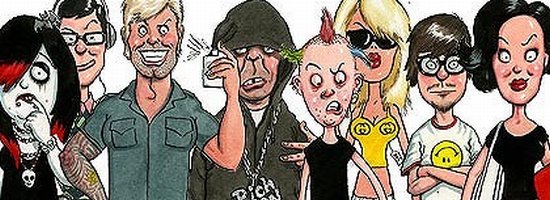
Youth cultures are formed from a specific dress code/ fashion, music influences, rebellion again what society deems 'the norm', having a collective identity with in this group and being marginalised and misunderstood. The word teenager falls into and means a constructed social group. This word teenager could have been created by marketers to seel products to this specific group of young people.
Ketley theory 2007- "Among young people themselves, a wide range of colourful labels such as "Goths, Skaters, Greebos and Surfers" are often used to make distinctions between the behaviours of specific frienship groups"
Critera for their to be a youth culture include:
- dress code
- music influences
- expression
- being marginalised
- having an opinionated leader
- literature- fan magazine and fan websites
- fitting into a group but then also being an outsider.
Collective identity is the self that finds its solidarity with others who are similar.
Mediated, this is how the media influences and portrays social groups and the influence this has on their identity.
"We" media means that the marginalised social groups
have often used media as a way of forgiving theirown collective identity.
Prosumers are producers and consumers, we consume and distribute- due to the proliferation of technology.
The mods and rockers were two conflicting British youth subcultures from the early to mid 1960s. Media coverage of the mods and rockers fighting in Brighton in 1964 began a moral panic about British youths and the two groups were labelled as 'folk devils'.
The Rockers
Their subculture centered around motor cycling and their appearance reflected that. Rockers wore protective clothing such as black leather jackets and motor cyle boots. The most common hair style was a pompadour, which was associated with 1950s rock and roll- the rockers music genre.
 The Mods
Their subculture was centred around fashion and music, and many mods rode scooters like Lambrettas and Vespas. Mods wore suits and other clean cut out fits, and preferred 1960s music genre such as soul, rhythm and blues.
The Mods
Their subculture was centred around fashion and music, and many mods rode scooters like Lambrettas and Vespas. Mods wore suits and other clean cut out fits, and preferred 1960s music genre such as soul, rhythm and blues.
The Teddy Boys were recognised for their Edwardian dress code. They experiemented with 'dandy' fashion statements, appearances and practices as an anitidote to Poverty (Frywell 1963). They listened to American Rock and Roll music, (some artists included Elvis Presley and James Dean) (Brak 1985). They used both narcisism and dandyism at the same time.
In articles they were described as 'teenage terrorists' to create a public scare. In another article they were described as 'very nauseating specimens of English youth... They are an awful disgrace to Brighton'. In other articles aggressive language was used to exaggerate the behaviour of the group. The other party involved were described as minor and small, suggesting that the Teddy boys were more dangerous, while they are at the bottom of the authority ladder. The teddy boys were an easy target for the media to blame because they had this reputation.
The Teddy Boys are associated with violence driven from a 'butch' dandyism, which sought to protest working class masculinity. They were apparently worse in winter because of the lack of jobs and access of places to go. In another article they were said to be that way becuase they lacked religious belief, which put them into darkness.

The Bowery Boys were an anti-Catholic and anti-Irish gang who were based North of the points district in New York city in the mid 19th century.
The very first youth subculture [the Bowery Boys] were portrayed as a negative group.
The Bowery boys are a youth subculture because...
 The do have a dress code- The Bowery boys dressed in black high beaver hats, red shirts, black flared trousers, high heeled calf skin boots ad black vests with oil slicked hair. They created a collective identity and chose how to portray themselves.
Rebellion- Most of this group took part in the New York City riots in 1863, they took part in the looting while fighting with rival gangs.
Cultural practices- the crime they were involved in. The peer pressure with in the group.
Conformity- The members conformed to the criminal acts that the group committed.
The marginalised themselves by distancing their dress code and behaviour from the subcultures around them.
Opinion Leader- he was thought to have been a boy called Mose the fireboy according to ''The Gangs of New York: An Informal History of the New York Underworld''.
The do have a dress code- The Bowery boys dressed in black high beaver hats, red shirts, black flared trousers, high heeled calf skin boots ad black vests with oil slicked hair. They created a collective identity and chose how to portray themselves.
Rebellion- Most of this group took part in the New York City riots in 1863, they took part in the looting while fighting with rival gangs.
Cultural practices- the crime they were involved in. The peer pressure with in the group.
Conformity- The members conformed to the criminal acts that the group committed.
The marginalised themselves by distancing their dress code and behaviour from the subcultures around them.
Opinion Leader- he was thought to have been a boy called Mose the fireboy according to ''The Gangs of New York: An Informal History of the New York Underworld''.